
Empowering future mathematics educators: Designing e-IBCA learning model to enhance decision-making skills
##plugins.themes.bootstrap3.article.sidebar##
##plugins.themes.bootstrap3.article.main##
Abstract
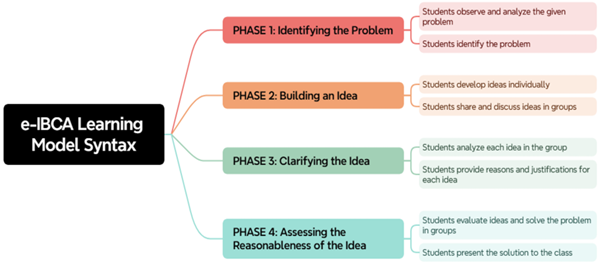
Decision-making skills must be trained in future mathematics educators because 21st-century skills have become a core component of teaching students. There is a need to develop new learning models to enhance students' decision-making abilities effectively. The decision-making skills of mathematics teacher candidates can be developed by giving them problem HOTS. The learning model designed is e-IBCA, which is short for electronic, with the syntax (1) Identifying the problem, (2) Building an idea, (3) Clarifying the idea, and (4) Assessing the reasonableness of the idea. This Research and Development study uses the model by Dick et al. (2015), which has four stages: planning, development, implementation, and evaluation, with revisions carried out continuously at each step. The research results show that teaching and student characteristics were analyzed at the planning stage. The development stage carried out the design of e-IBCA learning models, instruments, and learning tools with valid results. At the implementation stage, trials have yielded practical, effective results. At the evaluation stage, the e-IBCA learning model is feasible and can be used to develop future mathematics teachers' decision-making abilities. These findings suggest that the e-IBCA learning model can equip future mathematics teachers with 21st-century skills.
##plugins.themes.bootstrap3.article.details##

This work is licensed under a Creative Commons Attribution-ShareAlike 4.0 International License.
The author is responsible for acquiring the permission(s) to reproduce any copyrighted figures, tables, data, or text that are being used in the submitted paper. Authors should note that text quotations of more than 250 words from a published or copyrighted work will require grant of permission from the original publisher to reprint. The written permission letter(s) must be submitted together with the manuscript.References
Ausubel, D. P. (1968). A cognitive view: Educational psychology. Holt, Reinehert & Winston. https://cir.nii.ac.jp/crid/1571135649130892416
Aziz, A. A., Adam, I. N. H., Jasmis, J., Elias, S. J., & Mansor, S. (2021). N-gain and system usability scale analysis on game based learning for adult learners. In 2021 6th IEEE International Conference on Recent Advances and Innovations in Engineering (ICRAIE), (Vol. 6, pp. 1–6). https://doi.org/10.1109/ICRAIE52900.2021.9704013
Bacraharya, K. (2010). Teaching mathematics through ABC model of critical thinking. In Mathematics Education Forum, (Vol. 2, pp. 13–17).
Barak, M. (2009). Idea focusing versus idea generating: A course for teachers on inventive problem solving. Innovations in Education and Teaching International, 46(4), 345–356. https://doi.org/10.1080/14703290903301743
Bell, F. H. (1978). Teaching and learning mathematics (in secondary schools). W. C. Brown Company. https://books.google.co.id/books?id=kTHfAAAACAAJ
Borko, H., Roberts, S. A., & Shavelson, R. (2008). Teachers’ decision making: from Alan J. Bishop to today. In P. Clarkson & N. Presmeg (Eds.), Critical issues in mathematics education: Major contributions of Alan Bishop (pp. 37–67). Springer US. https://doi.org/10.1007/978-0-387-09673-5_4
Bruner, J. S. (1977). The process of education. Harvard University Press.
Cai, J., & Lester, F. (2010). Why is teaching with problem solving important to student learning. National council of teachers of mathematics, 13(12), 1–6.
Cohen, L., Manion, L., & Morrison, K. (2002). Research methods in education (5th ed.). Routledge. https://doi.org/10.4324/9780203224342
Dauer, J. M., Sorensen, A. E., & Jimenez, P. C. (2022). Using structured decision-making in the classroom to promote information literacy in the context of decision-making. Journal of College Science Teaching, 51(6), 75–82. https://doi.org/10.1080/0047231x.2022.12315652
DeVries, R. (2008). Piaget and Vygotsky: Theory and practice in early education. In T. L. Good (Ed.), 21st century education: A reference handbook (pp. 184–193). SAGE Publications. https://doi.org/10.4135/9781412964012.n20
Díaz-Chang, T., & Arredondo, E.-H. (2024). Assessing difficulty levels of mathematical tasks through subjective and behavioral criteria. International Journal of Engineering Pedagogy (iJEP), 14(7), 159–175. https://doi.org/10.3991/ijep.v14i7.46175
Dick, W., Carey, L., & Carey, J. O. (2015). The systematic design of instruction. Pearson.
Facione, N. C., & Facione, P. A. (2008). Critical thinking and clinical judgment. In N. C. Facione & P. A. Facione (Eds.), Critical thinking and clinical reasoning in the health sciences: A teaching anthology (Vol. 2008, pp. 1–14). The California Academic Press.
Gagne, R. M., Wager, W. W., Golas, K. C., Keller, J. M., & Russell, J. D. (2005). Principles of instructional design, 5th edition. Performance Improvement, 44(2), 44–46. https://doi.org/10.1002/pfi.4140440211
Giannetto, M. L., & Vincent, L. (2002). Sharing teaching ideas: Motivating students to achieve higher-order thinking skills through problem solving. The Mathematics Teacher, 95(9), 718–723. https://doi.org/10.5951/mt.95.9.0718
Goulet-Pelletier, J.-C., & Cousineau, D. (2018). A review of effect sizes and their confidence intervals, Part I: The Cohen's d family. The Quantitative Methods for Psychology, 14(4), 242–265. https://doi.org/10.20982/tqmp.14.4.p242
Graham, L. J., de Bruin, K., Lassig, C., & Spandagou, I. (2021). Context and implications document for: A scoping review of 20 years of research on differentiation: Investigating conceptualisation, characteristics and methods used. Review of Education, 9(1), 199–202. https://doi.org/10.1002/rev3.3240
Hariadi, B., Sunarto, M. J. D., Sagirani, T., Amelia, T., Lemantara, J., Prahani, B. K., & Jatmiko, B. (2021). Higher order thinking skills for improved learning outcomes among Indonesian students: A blended web mobile learning (BWML) model. International Journal of Interactive Mobile Technologies (iJIM), 15(7), 4–16. https://doi.org/10.3991/ijim.v15i07.17909
Haritas, I., & Harini, K. N. (2025). ‘Solving’ as a key course learning outcome (CLO) in postgraduate (PG) management education. The International Journal of Management Education, 23(3), 101225. https://doi.org/10.1016/j.ijme.2025.101225
Hasan, B., Juniati, D., & Masriyah, M. (2025). How do working memory capacity and math anxiety affect the creative reasoning abilities of prospective mathematics teachers? Edelweiss Applied Science and Technology, 9(5), 2911–2922. https://doi.org/10.55214/25768484.v9i5.7616
Hasyim, F., Prastowo, T., & Jatmiko, B. (2024). Critical thinking-independent learning: A model of learning to improve students' critical thinking skills. European Journal of Educational Research, 13(2), 747–762. https://doi.org/10.12973/eu-jer.13.2.747
Herodotou, C., Sharples, M., Gaved, M., Kukulska-Hulme, A., Rienties, B., Scanlon, E., & Whitelock, D. (2019). Innovative pedagogies of the future: An evidence-based selection. Frontiers in Education, 4, 00113. https://doi.org/10.3389/feduc.2019.00113
Hidayat, W., & Aripin, U. (2023). How to develop an E-LKPD with a scientific approach to achieving students' mathematical communication abilities? Infinity Journal, 12(1), 85–100. https://doi.org/10.22460/infinity.v12i1.p85-100
Hidayat, W., Aripin, U., & Widodo, S. A. (2025). Integration of ethno-modelling and 3N: An innovative digital worksheet framework to enhance students' mathematical critical thinking skills. Infinity Journal, 14(4), 1019–1042. https://doi.org/10.22460/infinity.v14i4.p1019-1042
Hidayat, W., Rohaeti, E. E., Ginanjar, A., & Putri, R. I. I. (2022). An ePub learning module and students' mathematical reasoning ability: A development study. Journal on Mathematics Education, 13(1), 103–118. https://doi.org/10.22342/jme.v13i1.pp103-118
Hidayat, W., Rohaeti, E. E., Hamidah, I., & Putri, R. I. I. (2023). How can android-based trigonometry learning improve the math learning process? Frontiers in Education, 7, 1016. https://doi.org/10.3389/feduc.2022.1101161
Jerrim, J., Prieto-Latorre, C., Marcenaro-Gutierrez, O. D., & Shure, N. (2025). Teacher self-efficacy, instructional practice, and student outcomes: Evidence from the TALIS video study. American Educational Research Journal, 62(2), 378–413. https://doi.org/10.3102/00028312241300265
Kana, F. (2015). Investigation of pre-service teachers’ communication skills [Türkçe Öğretmeni Adaylarının İletişim Becerilerinin İncelenmesi]. IJERs, 6(3), 34–42. https://dergipark.org.tr/en/pub/ijers/article/105688
Khadka, J., Dahal, N., Acharya, U., Puri, G., Subedi, N., & Hasan, M. K. (2025). Higher-order thinking skills in e-learning contexts in higher education: A phenomenological study. Frontiers in Education, 10, 1555541. https://doi.org/10.3389/feduc.2025.1555541
Kim, A. (2025). Impact of systematic support in teacher education and professional development on training-teaching alignment and instructional quality. Journal for STEM Education Research, 1–26. https://doi.org/10.1007/s41979-025-00154-3
Koh, J. H. L., Chai, C. S., Wong, B., & Hong, H.-Y. (2015). Design thinking for education: Conceptions and applications in teaching and learning. Springer Singapore. https://doi.org/10.1007/978-981-287-444-3
Lakens, D. (2013). Calculating and reporting effect sizes to facilitate cumulative science: a practical primer for t-tests and ANOVAs. Frontiers in psychology, 4, 00863. https://doi.org/10.3389/fpsyg.2013.00863
Leijen, Ä., Pedaste, M., Baucal, A., Poom-Valickis, K., & Lepp, L. (2024). What predicts instructional quality and commitments to teaching: Self-efficacy, pedagogical knowledge or integration of the two? Frontiers in psychology, 15, 1287313. https://doi.org/10.3389/fpsyg.2024.1287313
Lestari, N. D. S., Juniati, D., & Suwarsono, S. (2018). Gender differences in prospective teachers’ mathematical literacy: problem solving of occupational context on shipping company. Journal of Physics: Conference Series, 1008, 012074. https://doi.org/10.1088/1742-6596/1008/1/012074
Lestari, N. D. S., Juniati, D., & Suwarsono, S. (2019). The role of prospective mathematics teachers’ knowledge of content and students in integrating mathematical literacy. The New Educational Review, 57, 151–160.
Lukitasari, M., Handhika, J., & Murtafiah, W. (2018). Higher order thinking skills: Using e-portfolio in project-based learning. Journal of Physics: Conference Series, 983, 012047. https://doi.org/10.1088/1742-6596/983/1/012047
Lunenburg, F. C. (2010). The decision making process. In National Forum of Educational Administration & Supervision Journal, (Vol. 27, pp. 1–12).
Lupiáñez, J. L., Olivares, D., & Segovia, I. (2024). Examining the role played by resources, goals and orientations in primary teachers’ decision- making for problem-solving lesson plans. ZDM – Mathematics Education, 56(6), 1153–1167. https://doi.org/10.1007/s11858-024-01614-7
Mahanal, S., Zubaidah, S., Sumiati, I. D., Sari, T. M., & Ismirawati, N. (2019). RICOSRE: A learning model to develop critical thinking skills for students with different academic abilities. International Journal of Instruction, 12(2), 417–434. https://doi.org/10.29333/iji.2019.12227a
Maher, J. M., Markey, J. C., & Ebert-May, D. (2013). The other half of the story: Effect size analysis in quantitative research. CBE—Life Sciences Education, 12(3), 345–351. https://doi.org/10.1187/cbe.13-04-0082
McKenney, S., & Reeves, T. (2013). Conducting educational design research. Routledge. https://doi.org/10.4324/9780203818183
Meilantifa, M., & Budiarto, M. T. (2018). The development of teaching material: Rigorous mathematical thinking in a geometry classroom. Journal of Physics: Conference Series, 1088, 012062. https://doi.org/10.1088/1742-6596/1088/1/012062
Murtafiah, W., Lestari, N. D. S., Yahya, F. H., Apriandi, D., & Suprapto, E. (2023). How do students' decision-making ability in solving open-ended problems? Infinity Journal, 12(1), 133–150. https://doi.org/10.22460/infinity.v12i1.p133-150
Murtafiah, W., & Lukitasari, M. (2019). Developing pedagogical content knowledge of mathematics pre-service teacher through microteaching lesson study. Jurnal Pendidikan Matematika, 13(2), 201–218.
Murtafiah, W., Lukitasari, M., & Lestari, N. D. S. (2021). Exploring the decision-making process of pre-service teachers in solving mathematics literacy problems. Jurnal Pendidikan Matematika, 15(2), 145–160. https://doi.org/10.22342/jpm.15.2.13908.145-160
Murtafiah, W., Lukitasari, M., Lestari, N. D. S., Krisdiana, I., & Kholid, M. N. (2022). Towards a good problem solver through decision making model of teaching: A needs analysis. AIP Conference Proceedings, 2479(1), 020022. https://doi.org/10.1063/5.0099606
Murtafiah, W., Sa’dija, C., Chandra, T. D., Susiswo, S., & Zayyadi, M. (2020). Novice and experienced mathematics teachers’ decision making process in designing math problem. Journal of Physics: Conference Series, 1464(1), 012030. https://doi.org/10.1088/1742-6596/1464/1/012030
Murtafiah, W., Sa’dijah, C., Chandra, T. D., & Susiswo, S. (2019). Decision making of the winner of the national student creativity program in designing ICT-based learning media. TEM Journal, 8(3), 1039–1045. https://doi.org/10.18421/tem83-49
Murtafiah, W., Wardani, Y. N., Darmadi, D., & Widodo, S. A. (2024). Profile of open-start problem-solving with context Sarangan Lake viewed students' learning styles in junior high school. Journal of Education and Learning (EduLearn), 18(2), 448–461. https://doi.org/10.11591/edulearn.v18i2.21051
Ncube, M., & Luneta, K. (2025). Concept-based instruction: Improving learner performance in mathematics through conceptual understanding. Pythagoras, 46(1), a815. https://doi.org/10.4102/pythagoras.v46i1.815
Ndia, L., Solihatin, E., & Syahrial, Z. (2020). The effect of learning models and multiple intelligences on mathematics achievement. International Journal of Instruction, 13(2), 285–302. https://doi.org/10.29333/iji.2020.13220a
Ningsih, E. F., Sugiman, S., Budiningsih, C. A., & Surwanti, D. (2023). Is communicating mathematics part of the ease of online learning factor? Infinity Journal, 12(1), 151–164. https://doi.org/10.22460/infinity.v12i1.p151-164
Park, V., & Datnow, A. (2017). Ability grouping and differentiated instruction in an era of data-driven decision making. American Journal of Education, 123(2), 281–306. https://doi.org/10.1086/689930
Plomp, T., & Nieveen, N. (2013). An introduction to educational design research. Netherlands Institute for Curriculum Development (SLO).
Pozas, M., Letzel, V., & Schneider, C. (2019). Teachers and differentiated instruction: Exploring differentiation practices to address student diversity. Journal of Research in Special Educational Needs, 20(3), 217–230. https://doi.org/10.1111/1471-3802.12481
Purnomo, E. A., Sukestiyarno, Y. L., Junaedi, I., & Agoestanto, A. (2024). Stages of problem-solving in answering HOTS-based questions in differential calculus courses. Mathematics Teaching Research Journal, 15(6), 116–145.
Rahman, M. H. (2017). Using discovery learning to encourage creative thinking. International Journal of Social Sciences & Educational Studies, 4(2), 98–103. https://doi.org/10.23918/ijsses.v4i2sip98
Randahl, M. (2016). The mathematics textbook at tertiary level as curriculum material – exploring the teacher's decision-making process. International Journal of Mathematical Education in Science and Technology, 47(6), 897–916. https://doi.org/10.1080/0020739x.2015.1133853
Reigeluth, C. M., & Carr-Chellman, A. A. (2009). Instructional-design theories and models: Building a common knowledge base (Vol. 3). Routledge.
Reiter-Palmon, R., & Robinson, E. J. (2009). Problem identification and construction: What do we know, what is the future? Psychology of Aesthetics, Creativity, and the Arts, 3(1), 43–47. https://doi.org/10.1037/a0014629
Ristiana, M. G., Wahyudin, W., Herman, T., & Nurjanah, N. (2025). Analysis of mathematical communication ability on prospective elementary school teachers based on self-regulated learning level. Infinity Journal, 14(3), 607–632. https://doi.org/10.22460/infinity.v14i3.p607-632
Robertson, S., & Mullen, L. (2017). Digital history and argument. the Roy Rosenzweig Center for History and New Media.
Rohaeti, E. E., Nurjaman, A., Sari, I. P., Bernard, M., & Hidayat, W. (2019). Developing didactic design in triangle and rectangular toward students mathematical creative thinking through Visual Basic for PowerPoint. Journal of Physics: Conference Series, 1157(4), 042068. https://doi.org/10.1088/1742-6596/1157/4/042068
Sa'dijah, C., Murtafiah, W., Anwar, L., Nurhakiki, R., & Cahyowati, E. T. D. (2021). Teaching higher order thinking skills in mathematics classrooms: Gender differences. Journal on Mathematics Education, 12(1), 159–180. https://doi.org/10.22342/jme.12.1.13087.159-180
Samo, D. D., Darhim, D., & Kartasasmita, B. (2018). Culture-based contextual learning to increase problem-solving ability of first year university student. Journal on Mathematics Education, 9(1), 81–94. https://doi.org/10.22342/jme.9.1.4125.81-94
Sarkawi, N. I., Omar, M., Kamaruzaman, F. M., & Majid, M. Z. A. (2023). Teacher's readiness in implementing higher order thinking skills and its challenges. International Journal of Academic Research in Business & Social Sciences, 13(12), 3339–3345.
Shvarts, A., & Abrahamson, D. (2023). Coordination dynamics of semiotic mediation: A functional dynamic systems perspective on mathematics teaching/learning. Constructivist Foundations, 18(2), 220–234.
Siswono, T. Y. E., Kohar, A. W., Savitri, D., & Hartono, S. (2017). Context-based problems and how engineering students view and learn mathematics. World Transactions on Engineering and Technology Education, 15(4), 355–360.
Supratman, A. M. (2013). Piaget's theory in the development of creative thinking. Research in Mathematical Education, 17(4), 291–307. https://doi.org/10.7468/jksmed.2013.17.4.291
Swartz, R. J., Fischer, S. D., & Parks, S. (1998). Infusing the teaching of critical and creative thinking into secondary science: A lesson design handbook. Critical Thinking Books and Software.
Syamsuddin, A., Juniati, D., & Siswono, T. Y. E. (2020). Understanding the problem solving strategy based on cognitive style as a tool to investigate reflective thinking process of prospective teacher. Universal Journal of Educational Research, 8(6), 2614–2620. https://doi.org/10.13189/ujer.2020.080644
Treffinger, D. J., & Isaksen, S. G. (2013). Teaching and applying creative problem solving: Implications for at-risk students. International Journal for Talent Development and Creativity, 1(1), 87–97.
Trisniawati, T., Muanifah, M. T., Widodo, S. A., & Ardiyaningrum, M. (2019). Effect of Edmodo towards interests in mathematics learning. Journal of Physics: Conference Series, 1188, 012103. https://doi.org/10.1088/1742-6596/1188/1/012103
Unciti, O., & Palau, R. (2023). Teacher decision making tool: Development of a prototype to facilitate teacher decision making in the classroom. JOTSE: Journal of Technology and Science Education, 13(3), 740–760.
van Merriënboer, J. J. G. (2013). Perspectives on problem solving and instruction. Computers & Education, 64, 153–160. https://doi.org/10.1016/j.compedu.2012.11.025
Vieira, R. M., Tenreiro-Vieira, C., & Martins, I. P. (2011). Critical thinking: Conceptual clarification and its importance in science education. Science education international, 22(1), 43–54.
Vygotsky, L. S. (1978). Mind in society: Development of higher psychological processes. Harvard university press.
Wahono, B., Purmanna, A., Ramadhani, R., & Manalu, M. S. (2025). Strengthens the student collaboration and decision-making skills through integrated STEM education: A research and development study. Science education international, 36(1), 86–93. https://doi.org/10.33828/sei.v36.i1.9
Wahyuni, S., Erman, E., Sudikan, S., & Jatmiko, B. (2020). Edmodo-based interactive teaching materials as an alternative media for science learning to improve critical thinking skills of junior high school students. International Journal of Interactive Mobile Technologies (iJIM), 14(9), 166–181. https://doi.org/10.3991/ijim.v14i09.13041
Wang, Y., & Ruhe, G. (2007). The cognitive process of decision making. International Journal of Cognitive Informatics and Natural Intelligence, 1(2), 73–85. https://doi.org/10.4018/jcini.2007040105
Widodo, S. A., Wulandari, I., Ayuningtyas, A. D., Pusporini, W., Kusuma, D. A., & Dwipriyoko, E. (2024). What kind of relation and function worksheet based tri-N improve critical thinking skills? Kreano, Jurnal Matematika Kreatif-Inovatif, 15(2), 342–362.
Yapatang, L., & Polyiem, T. (2022). Development of the mathematical problem-solving ability using applied cooperative learning and Polya’s problem-solving process for grade 9 students. Journal of Education and Learning, 11(3), 40–46. https://doi.org/10.5539/jel.v11n3p40
Zhou, Y., Gan, L., Chen, J., Wijaya, T. T., & Li, Y. (2023). Development and validation of a higher-order thinking skills assessment scale for pre-service teachers. Thinking Skills and Creativity, 48, 101272. https://doi.org/10.1016/j.tsc.2023.101272
Zubaidah, S., Corebima, A. D., Mahanal, S., & Mistianah, M. (2018). Revealing the relationship between reading interest and critical thinking skills through remap GI and remap Jigsaw. International Journal of Instruction, 11(2), 41–56. https://doi.org/10.12973/iji.2018.1124a